Porky’s Pulpit: Barbecue “Evolution”

When the Private Equity Beat blog of the Wall Street Journal features a post about barbecue, it’s worth reading.  And they posted a good one toward the end of 2009.  In “Debating Evolution – Barbecue Evolution, That Is,” WSJ blogger Josh Beckerman, who admits he is no dyed-in-the-pig-wool barbecue fundamentalist, nonetheless takes a creationist-worthy stand against the so-called “evolution” of ‘cue. 

What has Beckerman riled up?  This press release entitled “The Barbecue Evolution” that was put out by a large company called Sadler’s.  The press release says, in part: “BBQ isn’t just for backyard parties anymore. Sophisticated barbecue was named a Top 10 Flavor Trend in 2009 by Flavor & The Menu and is predicted to go even more upscale with ethnic and regional flavors in 2010… .”

Beckerman responds to Sadler’s slick press release with fire and brimstone worthy of, well, a BBQ Jew, writing that he has no problem with the concept of mass-produced pit-smoked ‘cue but he’s “not so sure about brisket bow-tie pasta, one of the recipes – along with pulled pork Asian wraps and shaved pork quesadillas – that the company offers to ‘customers who want to experiment with upscale barbecue trends.'”  

He continues his sermon, offering, “Nor do we completely agree that ‘mango salsa or chipotle sauces are ideal compliments to the hardwood flavors of authentic, pit-smoked barbecue meats.’  Although fusion has its place in the world of food, we think barbecue may not be that place.” 

Preach it, Beckerman!

Happy Meat Week

Happy Meat Week everyone!  Meat Week is one of the greatest ideas ever–ranking right up there with cooking whole hog over coals and the invention of vinegar–but the only North Carolina chapter is in Charlotte.  Obviously folks need to step up and start other NC chapters by next year.  Who’s going to take on this awesome responsibility? I call not it… but I will be happy to participate.

Kraft: “The Boss Sauce”

I stumbled into this classic piece of American television history somewhat disturbing blaxploitation commercial and thought it was interesting.  Hopefully this video provides yet another compelling reason to put down the Kraft and pick up a bottle of sauce from your local barbecue joint.  Local sauce is boss, man. Groovy.  Ya dig?


BBQ in the News: December 2009

Today marks the debut of an occasional feature called BBQ in the News, in which we share ‘cue related stories that come from near and far, and range from unimportant to not that important. Enjoy.

The Grinch Who Stole the Birthday Brisket – This story comes from Houma, Louisiana courtesy of The Daily Comet, which I think may be the paper Clark Kent worked at before moving up to The Daily Planet.  This sad story begins with Jonathon Pepper buying his wife Brandi a brisket for her birthday.  (That’s the gift that keeps on giving, Clark.)  Unfortunately, after 2 days of marinating, the brisket was stolen from the couple’s smoker while it cooked.  “I would honestly like to know who steals someone else’s barbecue in their backyard,” bemoaned Mrs. Pepper.   My theory:  Mrs. Pepper herself, in a fit of rage that her husband bought her brisket instead of a pork shoulder.

Free New Year’s BBQ in Fayetteville – According to the Fayetteville Observer, “The public is invited to a free feast of barbecue, collard greens, sweet potatoes and black-eyed peas on New Year’s Day.”  Need I say more?  Get thee to Cumberland County!

The Barbecue Gazebo – Okay, technically this is not a news item.  Still, did you know that you can purchase a “barbecue gazebo” from your good friends at Hammacher Schlemmer for less than $1,000 plus shipping?  Well, actually, the website says this item is no longer available.  Oh well, in that case I won’t mock it.

Barbecue Fork Involved in Stabbing  – According to Australia’s AdelaideNow, “TWO men spent their Rudd Government stimulus packages on drugs before one viciously stabbed the other in an argument over sugar.”  The article is very choppy and difficult to understand–as if the reporter was also using drugs–but it sounds like the meth using stabbing victim wielded a barbecue fork, while the meth using stabber wielded a knife.  Knife trumps fork.

Lexington Barbecue Tourism – According to The Dispatch, the slightly more than one year-old Lexington Visitor’s Center has been an asset to the local economy, in no small part due to its promotion of barbecue-related tourism.  More than 3,300 visitors have come through the doors since the Center opened on December 1, 2008.

McRib’s Revenge – The greatest threat to real barbecue since the invention of the propane cooker, the McRib has returned… at least to Las Cruces, according to hometown paper the Sun-News.  Run for your lives, good people of New Mexico, save yourselves!  Or at least heed the journalist’s advice: “Don’t ask too many questions.  What kind of meat is this? Don’t go there. If you overthink this, the McRib will start morphing on you. If you think, ‘This sort of tastes like chicken,’ it will. It can also sort of taste like beef and sort of like pork.”

Porco Pizza: “Wise person who if dealt with a stuffed pig”

Do any of you BBQ Jew readers speak Portuguese?  If so, your help is needed in figuring out what the heck is going on in this video about a Portuguese pig pizza.  According to the website Boing Boing (surely a reliable source judging from the name), the video “documents the creation of the revolting Porco Pizza, a pizza whose crust is an entire, flattened suckling pig.” (Thanks to reader/BBQ buddy Eric “Raw Food Hog” Calhoun for the story idea.)

Unfortunately, I speak no Portuguese and I have no time to learn given my busy barbecue eating schedule.  Luckily, I discovered an article on the porco pizza to help explain things.  Unfortunately, like the video the article is also in Portuguese.  Luckily, I was able to find a free web-based translation service.  Unfortunately, the translation is a wee bit confusing, as this abridged transcript reveals: 

“Today the Oba presents an unusual plate at least. This Saturday I was invited for a confraternização of a group of friends intitled “the Eaters,” heading given in function of all the fridays to go in a different restaurant… The offered cardápio was the “Paraguayan Pig” or “Pig Pizza “, as some had called. Wise person who if dealt with a stuffed pig, but did not imagine the content of the filling….  Arriving at the mansion, I was to know the process of the preparation. In the reality, it was a boned and open wild boar, that rested in the grate with a golden one to full the eyes… 

1 – The pig (or in the case wild boar) boned is tempered with left pickling brine and on of paper aluminum, with the leather for top, until dourar.
2 – Then it is turned for another grate, of this time with the leather for low e without aluminum.
3 – The grate is returned to the fire.
4 – The wild boar is covered by one mixture of cheese, ham, tomatoe, maize, peas, olives, palmito, onion and orégano… Then it is served, abundantly served (he is enough to see my plate).

…Difficult to explain the delight that was. The meat baked in the accurate point… Detail that beyond the wild boar, still had a rib made in soil fire, melting of so soft….”
 
Here’s my summary: Dude went out to eat with some other dudes.  Dudes who knew dude’s dudes made some crazy pig pizza dish for all the dudes.  Dude thought pig pizza tasted pretty dang good.  Dude ate his fill of pig pizza.  Dude wants to share his love for pig pizza with the world, but not many dudes in the world speak Portuguese. 

Porco Pizza!

BBQ Book Review: Smokestack Lightning

I recently read Smokestack Lightning and strongly recommend you drop whatever you are doing to buy a copy right now.  Although this book only includes one chapter on North Carolina barbecue (and it is a chapter shared with–gasp–South Carolina), it is one of the best books on barbecue ever written.  Smokestack Lightning–the title taken from the classic Howlin’ Wolf song–is in small part a barbecue guide book, in even smaller part a cookbook and in large part a sociological treatise on American culture.  Whichever part you’re most interested in, all parts of Smokestack Lighting are well worth reading.   

Author Lolis Eric Elie, who when he set out to write the book was the road manager for the Winton Marsalis Septet, writes in the preface: “Our thesis was this. Barbecue reflects and embodies all the important themes in American history and culture–region, race, migration, immigration, religion, politics.  Yet this art, so vital to our national identity was dying or at least endangered.  We were half right…  we were also half wrong.” 

In the introduction, Elie continues to explain the underlying purpose of the book.  “We know that barbecue is a metaphor for American culture in a broad sense,” he writes, “and that it is a more appropriate metaphor than any other American food.  Barbecue alone encompasses the high- and lowbrows, the sacred and the profane, the urban and the rural, the learned and the unlettered, the blacks, the browns, the yellows, the reds, and the whites.  Barbecue, then, is a fitting barometer for the changes, good and bad, that have taken place in the country, and this book, ostensibly about that food, is really about the people and places and consistencies and changes that produce it.”

As the quotes above indicate, there are some pretty heady themes in Smokestack Lightning.  It’s a refreshing change to read a barbecue book that goes so deep into its subject–well past the hickory and mesquite smoke, well past the pork and beef, and straight into the marrow of American culture, history and race relations.  But despite all the serious themes that help carry the book forward, Smokestack Lightning stops short of being too serious for its own good and certainly is never dull.  Quite the opposite, it is full of rich storytelling and humor.  One funny anecdote has a relative of notoriously surly jazz legend Miles Davis’ trying to impress him by bringing him barbecue from his hometown of East St. Louis, where snoots are the specialty.  After traveling by plane with this carefully packaged barbecue treat for Miles, the only response the relative gets from him is, “Motherf*&ker, why you f%*k up my snoots?”

Smokestack Lightning was first published in 1996 and the second edition was printed in 2005.  It is not currently in print but it is available used on Amazon.com and other sites.  The fact that the book is a few years out of date only adds to the timeless nature of the stories, the people featured, and the splendid black and white photography by Frank Stewart.

Fortunate Pig

Notwithstanding that darkest of dark period in German history that Jews try in vain to forget (i.e., David Hasselhoff’s chart-topping singing career, which some call the “Hoffocaust”), the Germans do have a proud culture.  Although native Germans have no history of preparing chopped pork barbecue–at least until they emigrated to the United States and settled in Lexington, NC–they do know a thing or two about cooking pig (knockwurst anyone?). 

The Hoff making German women swoon.

Germans’ fondness for pig finds its way into their language.  The word “Glücksschwein” translates to “good fortune pig,” a symbol of good luck that has its origins in another phrase.  The German phrase “Du hast Schwein gehabt” is said when someone has had good luck.  It means, literally, “you have had pig.”  According to completely unreliable sources on the Interweb, the saying dates back to scarcer times, when having a pig to eat meant you were lucky.  What does this have to do with barbecue?  Not a heckuva lot.

Porky’s Pulpit: BBQ in my DNA

According to a recent story on NPR (National Piglet Radio?), the DNA of the domesticated pig has been sequenced.  The NPR report notes that, “The sequence comes from a single pig, formally known as UIUC 2-14, although she’s also called TJ Tabasco.”  Texas Pete would have been a far more respectable name for a pig, but the research is impressive nevertheless. 

Of surprise to the researchers, but not to anyone who has ever fallen in love with a perfectly prepared BBQ tray,  was the finding that the pig’s genome structure and sequence is very similar to that of a human.  Besides bothering folks who don’t believe in evolution (and opening the door to various Jesse Helms jokes), this finding is causing me some anxiety as I ponder the technical definition of cannibalism…

BACONJEW

bacon

We just discovered we have a brother-in-arms trotters: Marc Schapiro, author of baconjew.com.  Marc’s blog is a humorous ode to that almost-as-good-as-barbecue meat, bacon.  It’s good to know there is another Jew out there wasting his time writing about, and salivating over, forbidden meat.

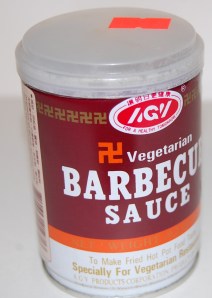
Anti-Semitic Vegeterian Barbecue Sauce?

Hmm, this ain't a classic vinegar sauce.

Hmm, this ain't a classic vinegar sauce.

A few weeks ago we received the inset photo from Joel Haas, a Raleigh-based sculptor and author of the recent novel Adlerhof, which he describes as a story about “NC Jews, race riots, cats, Nazis, naked women, money and asparagus.”  (I’ll leave it to the readers to decide if the world really needs yet another book about Nazis, naked women and asparagus.)

Joel writes: “My first encounter with Asia (southern Taiwan) was in late 2004 when I went to the city of Kaohsiung to represent the USA in the International Steel Sculpture Festival.  Riding in from the airport to the Kaohsiung harbor, I was reminded that the Nazis and Hitler had appropriated one of the great Buddhist symbols for peace and long life, the swastika.  A towering Buddhist temple, built much like a 1950s skyscraper, loomed before me, its 15 foot high swastikas on all four sides lit with spotlights.”  Interesting stuff, Joel, but what’s it got to do with this “barbecue” sauce?    

“Back home in the USA,” Joel explains, “my wife and I took to haunting the Grand Asia Market over in South Hills in Raleigh for authentic Taiwanese foods.  It was here I found what is a startling contradiction in both taste and concept for an American–vegetarian barbecue sauce in a can covered with swastikas.” 
 
Rest easy, NC barbecue fans, as this sauce is actually intended for Asian hot pot cooking.  However, at only $3 a can, in a pinch this sauce might make a decent substitute for classic vinegar & hot pepper sauces found at barbecue joints across the state.  But between the swastika and, redundantly, the word “vegetarian,” I think I’ll pass. After all, there is some evidence Hitler was a vegeterian (though not a particularly dedicated one, it seems).