

Thanks to John Shelton Reed for sharing the below music video about Lexington barbecue. Eat your heart out, MTV:
Filed under: 'Cue Culture | Tagged: Lexington style, Music | 2 Comments »
Thanks to John Shelton Reed for sharing the below music video about Lexington barbecue. Eat your heart out, MTV:
Filed under: 'Cue Culture | Tagged: Lexington style, Music | 2 Comments »
It’s sacrilege for me to write what I’m about to write, but sometimes sacrilege is inevitable on a site called BBQJew.com. So please don’t hate me for admitting that, if there is such a thing as reincarnation ( and I’m waiting on BBQHindu.com for the answer to that question), I hope to be reincarnated as a Texas pitmaster. Or at least a Texan.
 North Carolina whole hog cooking is the nation’s original barbecue and when done right is probably the most perfect food anywhere, but even I must admit that present day Texas is the superior barbecue state. Whereas wood cooking is all but extinct in North Carolina, with only a few dozen traditional pit-cookers still in existence, in Texas traditional cooking methods remain commonplace. Perhaps because barbecue is part of Texans’ sometimes over-the-top self-identity, traditional cooking techniques and recipes remain important to Texas culture in a way that is not matched in the Tar Heel state. For every terrific traditional wood-burning pit in North Caroina, Texas can claim several. For every whole hog or pork shoulder pit-cooked in Carolina today, Texans probably smoked 50 times that much meat. Lucky for us Carolinians, Texas’ rich barbecue culture is documented efficiently, if sometimes formulaicly, in Gloria Corral’s Barbecue Lover’s Guide to Austin.
Corral admits upfront that she is a newcomer to Texas, but she approaches her new state of residence with wide-eyed enthusiasm and a giant appetite (after all, everything is bigger in Texas). Sometimes it takes an outsider–free of long-established biases–to fairly judge barbecue with an open mind and an eager stomach.
Through her guide book, Corral sets out to find barbecue anywhere and everywhere she can in Austin and the surrounding Hill Country, an area that is chock full of deservedly famous barbecue joints. As Corral writes in her introduction, “The Austin area is known as the Central Texas Barbecue Belt. It became clear to me that this food needed more than casual investigation, so I signed up for an Austin public library card and dug in.”
Thankfully, Corral also dug into her work beyond the confines of the library, diligently eating her way through the brisket, ribs, sausage and other smoked delicacies of the Hill Country. In total, the Barbecue Lover’s Guide to Austin details Corral’s visits to about 75 Austin-area barbecue joints, including some that most barbecue fanatics have heard of and many that are more obscure. She does a fine, workman-like job of describing the atmosphere and food of each joint, in the process heaping praise on her favorite joints while refraining from badmouthing those joints that are less than sublime.
This is Corral’s first book and its prose is not as polished as that of more seasoned writers. Still, the Barbecue Lover’s Guide to Austin does a good job of fulfilling its promise: it serves as a succinct, practical guide to many of the barbecue joints of the Hill Country. The fact that I salivate every time I crack open the book is evidence enough that her book is worth buying for your next trip to the area. I am certainly eager to travel to Austin and test out the guide for myself; hopefully prior to discovering whether reincarnation exists.
Filed under: 'Cue Culture, Restaurants & Reviews | Tagged: Outside NC, Texas | 3 Comments »


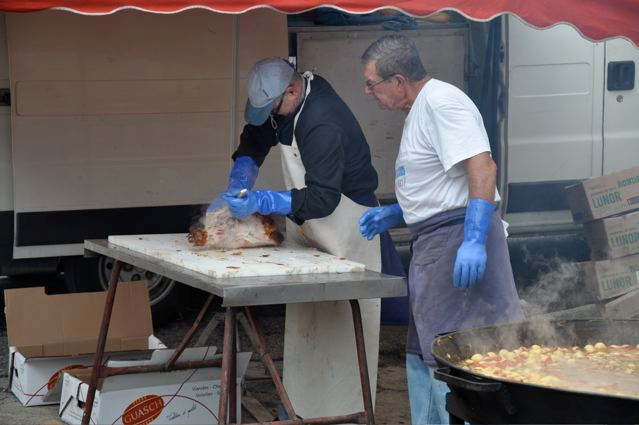
Sorry, Virginia, Brunswick stew was invented in France.


Filed under: 'Cue Culture | Tagged: International, Outside NC, Wood-cooked | 1 Comment »
Today’s post comes to us via a FOBJ (Friend of Barbecue Jew), a rare breed indeed. Bennett Brown of LowCountry Barbecue in Atlanta wrote in to ask if I was willing to run a guest post from him. Far be it from me to refuse a fellow barbecue traveler’s generous offer. So, like God before me, I am resting (though not on the 7th day) and allowing my humble servants to work. Without further ado, here’s Mr. Brown’s introduction to Georgia barbecue along with a simple Georgia-style sauce recipe that shouldn’t look too foreign to devotees of North Carolina’s Lexington-style dip.
Barbecuin’ It in Georgia
As many of you probably already know, barbecue is not just a food but a cooking method that takes place all over the world. And just like the spelling, which is spelled a handful of ways (BBQ, Bar-b-que, barbeque, etc.), barbecue can be prepared a dozen different ways.
In England, barbecuing is done over direct high heat; however, grilling done under a direct heat source is known in America as broiling. In Hong Kong, everyone gathers around the fire and cooks their own meat on long forks or skewers like cooking hotdogs at a campfire. In America, barbecuing is done over an indirect heat source referred to as “low and slow.” And in Georgia, we do it “low and slow” over a pit.
Pit cooking originated from early settlers who then adopted the grilling and smoking methods from Native Americans. The pit can either be dug in the ground or built up with cinder blocks. If cooking a whole hog, it is usually laid flat, butterflied-style on a grate, placed over the pit, and then usually covered with a piece of tin or sheet metal in order to keep heat from escaping.
While the heat can be generated with coals or charcoal, Georgians traditionally use wood. Pecan or apple tree wood are believed to give flavor to the meat. While whole hogs are very popular, whole chickens, ribs and hams are common as well. Closer to the coast, you will find fish, oysters, and shrimp being barbecued as well. No matter what is roasting over the pit, barbecuing is an essential part of many Georgia gatherings including the annual Georgia General Assembly’s whole hog supper before the legislative session begins.
While barbecue is different all over the world, the act of bringing family and friends together to celebrate and converse is the common link. Even in Georgia, the best sides and ways to cook are debated constantly. At the end of the day, an event bringing an intimacy only a few meals can accomplish is commended.
Almost as important as the meat itself – the sauce that accompanies it. Georgia gets its influence of barbecue sauce from all around the region including the Carolinas, Tennessee, and even Texas and melds the best of all of them into a glorious vinegar, ketchup and mustard based sauce, sometimes with a little heat and sometimes with tang from a little lemon slices. As you can tell, Georgians are pretty open when it comes to barbecue sauce as long as we have some!
Below is a recipe that uses most of the classic ingredients you would find in a Georgia vinegar sauce but with a little twist (of lemon that is!): Continue reading
Filed under: 'Cue Culture, Cooking | Tagged: Georgia, Outside NC, Recipes | Leave a comment »
A little over a month ago I ran this post about an amateur historian’s take on Goldsboro’s rich barbecue history. I recently was able to track down the author, Carl Eugene (“Gene”) McBride, Jr. He not only agreed to allow me to continue to share his magnum opus porkus online but offered a new and improved version. The revised version corrects a few minor errors and is available here for your reading pleasure: GoldsboroBarbecue. (I also updated the original post to link to this revised document.) It’s a terrific read so please do check it out.
So, who is this mysterious McBride fellow anyway? A Goldsboro native who now lives in barbecue purgatory on the left coast, it turns out. As Gene told me over email: “I grew up in Goldsboro until I went off to UNC-Chapel Hill in 1965. Although I now live in Los Angeles, I have visited Goldsboro every year since then. You are correct that Goldsboro is truly a barbecue haven. I wish I had some of that ‘cue right now!” If any Tar Heel travelers are planning a journey to the City of Angels, I am confident that Gene would be more than happy to pay your airfare if you simply bring him a plate of his precious ‘cue.
Filed under: 'Cue Culture | Tagged: Goldsboro, Wayne County | Leave a comment »
In addition to being a truly outstanding teacher whose talents I experienced firsthand as a middle school student way back when, Henry “Fire” Walker is also the man whose family introduced me to pig pickin’s. Over the past few decades I’ve been to countless pig pickin’s at Henry’s home. Each one of the gatherings is characterized by delicious pigmeat and potluck sides, lively music, somewhat unpredictable pyrotechnics, enough puns that if they were burning coals they’d cook the hog themselves, and a healthy serving of community. But don’t take my word for it, take Henry’s.
Henry wrote the following poem eight days after his most recent pig pickin’, which I regretably missed, and he gave me permission to share it here. The poem speaks to the sense of fellowship and connection that I feel at pig pickin’s and other meals shared with good friends and family. Without further ado…
my wife and I pull enough out of our
introversion to answer the call of the young
to help them learn to like themselves
and to find how to realize the power within
that craves the skills to express itself,
we also, for decades, have pulled off pigpickings
through which we invite colleague, and friend, and acquaintance,
to join us for communal food, and drink, and music, and visiting,
most we invite do not find the way to us and the pigpicking,
for a lot can come between the possible and the actual,
last night, as I enjoyed community birthing itself,
I loved the sense of creation
as the disparate become connected,
around the blazing fire,
under the defining lights within the sheltering oak,
mesmerized by the music flowing from
the musicians’ creation and performance of their own songs,
all of this blazes against how the light can die,
a circle of good folks who become even better
by connecting with the other,
tears well up in me as I appreciate the connections made,
partly through our help,
the power of any community, once created,
is a fire that holds back all the surrounding, encroaching darkness.
by Henry H. Walker
October 30, ’11
See more of Henry’s poetry on his blog (every modern-day poet, like every BBQ nerd, needs a blog).
Filed under: 'Cue Culture | Tagged: Porky poetry | Leave a comment »
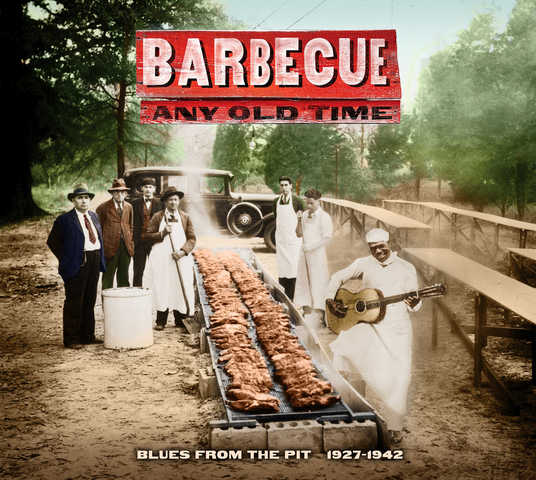 “In the early twentieth century, millions of Southerners moved from hardluck farms to the big cities of the North and West. As the Great Migration carried Southern barbecue to new locales, it did the same for Southern music.”*
If BBQJew.com had a soundtrack, without a doubt it would be the terrific new barbecue-blues compilation album, “Barbecue Any Old Time.” The collection of vintage, early 20th century blues music about barbecue and other such meats was released in September on North Carolina’s own Old Hat Records. Like the authentic, soulful food paid homage to throughout the album, it’s hard to find music this flavorful in today’s quick-cooked world.
One would expect an album that is a compilation of blues songs about barbecue and other southern meat treats would be a novelty record, and to a certain degree it is. Yet despite the novelty of the concept, the album is worthy of repeated listening. Many of the songs are as well-crafted as any of the era, and the music varies widely from track to track despite the uniformly carnivorous theme. If your musical palate includes a taste for country blues, urban blues, string bands or even vaudeville there is something on Barbecue Any Old Time for you.
Barbecue Any Old Time serves as a terrific crash course on blues music from the 1920s to early 1940s: it is fueled by energy and mischief, prepared with great vocals and musicianship, and basted in numerous double-entendres. Lyrics like “pepper sauce mama, you make my meat red hot” are among the more over the top refrains, but there are plenty of memorable lines to choose from on an album featuring songs like “Meat Cuttin’ Blues,” “Fat Meat is Good Meat,” and “Pig Meat is What I Crave.” In fact, you may find yourself blushing next time you sit down for a meal.
Despite plenty of songs that lean heavily on sexual innuendo, like good barbecue the album is not as simple as it may first seem. Taken as a collection, the songs on Barbecue Any Old Time have a hidden complexity to them that make you want to return again and again. Perhaps that is no surprise given the caliber of musicians featured on the album. The track listing includes blues legends like Memphis Minnie, Blind Boy Fuller and Brownie McGhee, as well as far lesser known artists like Frankie “Half Pint” Jaxon, Bessie Jackson, and The Two Charlies. The liner notes are top notch, featuring a compelling essay by Tom Hanchett, Staff Historian at Charlotte’s Levine Museum of the New South, and succinct but fascinating descriptions of each track. Also included are vintage images of barbecue joints, blues musicians, record posters, and even President Andrew Jackson (read the notes and you’ll learn why).
Musical highlights include “Big Boy” Teddy Edwards’ funny but not slight, “Who Did You Give My Barbecue To?”; Frankie Jaxon’s smokey-smooth vocals on “Give Me a Pig’s Foot and a Bottle of Beer”; the rollicking “Pepper Sauce Mama” by Charlie Campbell and His Red Peppers; and Barbecue Bob’s expertly crafted “Barbecue Blues.” Though not every song reaches the pit-cooked perfection of these ones, nearly all are worth tasting more than once. Barbecue Any Old Time indeed. Congratulations to Old Hat Records for tending the fires on this slow-cooked instant classic.
*Quote from a letter by Old Hat Records promoting the album.
Filed under: 'Cue Culture | Tagged: Music, Sex | Leave a comment »
According to the Salisbury Post, China Grove Police Department officer David Lambert will be sitting on top of Gary’s Barbecue for 31 hours starting at 3 p.m. today. The annual Cop on Top fundraiser benefits the Rowan County Relay for Life. The event is all in good fun so I imagine officer Lambert will have no problem whatsoever with you making up your own cop-“pig” jokes… provided you donate to the fundraiser first.
For more details, contact Lambert at dlambert at cgpolice.com or 704.855.5041, though I am not sure if he’ll be checking his messages roofside. If you live in China Grove I suppose you can just dial 9-1-1. The article doesn’t mention what officer Lambert will be eating while he sits on top of the roof, but my money is on barbecue.
Filed under: 'Cue Culture | Tagged: China Grove, Rowan County | Leave a comment »
Goldsboro, a city of a little under 40,000 people in eastern North Carolina, has some of the state’s richest barbecue history. Thus, I was particularly pleased to receive the below email, written by Johnnie and Peggy Hood, and forward to me by Dave Schiller, all of whom recently attended their 50th Goldsboro High School anniversary. Better yet, the email included an attached history of Goldsboro barbecue written by Carl Eugene McBride, Jr., whom I am currently trying to track down to be sure he is okay with me including his writing on this site… I sure hope he is because it is excellent and deserves an audience.
“(Goldsboro, NC 10/01/11) — What started out as a few friends going to Wilber’s Barbecue for lunch morphed into a GHS class of 1961 reunion family style luncheon at Wilberdean Shirley’s Barbecue Emporium. Classmates feasted on barbecue pork (of course), barbecue chicken, fried chicken, slaw, potato salad, Brunswick stew, hushpuppies, and biscuits (sopping biscuits like granny used to make). For dessert we enjoyed banana pudding that, we were told, Wilber himself stayed up all night cooking.
Conversation topics ranged from “whatever happened to ole so and so?” to stories from those no longer living in eastern North Carolina about the putrid and disgusting things some people put in their barbecue sauce. Some were shocked to learn that some well-meaning cooks put catsup, or mustard, or molasses, or brown sugar, just to name a few things, in the sauce and then serve it to unsuspecting guests.
It was agreed that the reason that we GHS graduates are so good looking, so intelligent, and so healthy is probably the Goldsboro barbecue we consumed as children. Harriet Taylor Ross removed any doubt by providing a PDF file history of the holy grub from Goldsboro [Editor’s note: This link opens a fascinating, 19-page history of Goldsboro barbecue]… It should be required reading in all Goldsboro Public Schools along with other important stuff that’s no longer taught.
The fiftieth reunion is a once in a lifetime event. We enjoyed ours.”
Filed under: 'Cue Culture | Tagged: Goldsboro, Wayne County | 1 Comment »
 Barbecue and tobacco go together like tobacco and blues, and through the transitive property barbecue and blues go together just as well. In fact, the history of blues music and barbecue are both intertwined with tobacco. While pig pickings were a traditional harvest time tradition in the country, blues musicians crowded urban tobacco auction sites when the crop came in for sale.
In North Carolina, tobacco towns like Durham have a rich history of blues music centered around its tobacco industry. North Carolina’s primary contribution to the blues, a style called the Piedmont Blues, was made famous by artists like Blind Boy Fuller, Sonny Terry and Brownie McGee and the Reverend Gary Davis, as well as somewhat lesser know artists like John Dee Holeman, who still lives in Durham just blocks from the old tobacco district.
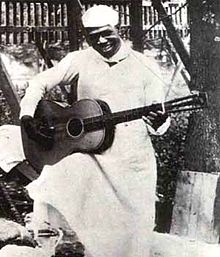
Perhaps it is no surprise that the blues industry created an artist who could capture the barbecue demographic. Robert Hicks (1902-1931), better know by his recording name Barbecue Bob, was a Georgia native who worked at a barbecue restaurant in Atlanta at the time he was signed to Columbia Records. The label decided that they could cash in on Hicks’ barbecue connection, and gave him his nickname. Barbecue Bob played in the Piedmont Blues style, bringing a country blues flair to his work. Barbecue Bob’s first single was, predictably, called “Barbecue Blues,” and sold a pace setting 15,000 copies. The publicity photo (inset) of Barbecue Bob wearing a chef’s uniform proably didn’t hurt sales. How the song relates to barbecue, however, is anyone’s guess; it is certainly not an obvious lyrical connection.
Although there is no mention of slow cooking hogs, I still hope you enjoy the recording of the “Barbecue Blues” below. The song shows off Barbecue Bob’s terrific beyond-his-years voice, guitar picking skills and even BBQJew.com-appropriate lyrics (“I’m going to tell you now gal/like Gypsy told the Jew/If you don’t want me/it’s a cinch I don’t want you.”) Now THAT’s the Jews blues.
[http://www.youtube.com/watch?v=Fgz0rowuRpo]
Filed under: 'Cue Culture | Tagged: Music | 3 Comments »
 BBQ Jew