President’s Day Barbecue

Barbecue and Presidents go together like, well, barbecue and slaw (or, if you prefer, First Ladies and Presidents). 

In addition to the longstanding and ongoing link between barbecue and political rallies/campaign stops, America’s barbecue traditions date back all the way to that guy with the funny hair who shows up on the one dollar bill.  According to North Carolina’s premier barbecue sociologist, John Shelton Reed, writing in an article you can read here: “When George Washington ‘went in to Alexandria to a Barbecue and stayed all Night,’ as he wrote in his diary for May 27, 1769, he won eight shillings playing cards and probably ate meat from a whole hog, cooked for hours over hardwood coals, then chopped or ‘pulled.'”  Whether the barbecue Washington ate was cooked over the coals of cherry trees and how he managed to eat the ‘cue with his wooden dentures are mysteries. 

Reed continues, “By the early nineteenth century at the latest, a sauce of vinegar and cayenne pepper (originally West Indian) was being sprinkled on the finished product.  This [barbecue] can be found to this day in eastern North Carolina… virtually unchanged… Barbecue is now high on the extensive list of cultural markers dividing the coastal plain from the piedmont.  The upcountry tradition lacks the antiquity of George Washington’s version, but it too has a presidential imprimatur:  the Reagan administration engaged the catering services of Wayne Monk of Lexington for the 1983 Economic Summit in Williamsburg.” 

Reagan is not the only President to have served barbecue at official state functions, and so long as people from BBQ friendly places–southerners born and bred like LBJ and Clinton, southerners-by-way-of-Connecticut like the Bushes, and southerners-by-way-of-the-BBQ-diaspora-to-Chicago like Obama–are elected as President, the barbecue tradition that started in Washington’s day looks like it will continue well into the future.  And that, my friends, is one reason I am hopeful that all Alaskans will remain content staying home and eating Baked Alaska rather than running for President.

Notable Quotable: Jim Auchmutey

“Of all the signature foods of the South, none unites and divides the region like barbecue. When it comes to barbecue, southerners cannot agree on meat, sauce, technique, side dishes, or even how to spell the word. What they can agree on is that barbecue in all its variety is one of the fond traditions that makes the South the South. It drifts across class and racial distinctions like the sweet vapors of pork hissing over hickory embers.” – Jim Auchmutey, Atlanta Journal-Constitution in The New Encyclopedia of Southern Culture Volume 7: Foodways.

First Church of Barbecue

I have made many references on this blog about worshipping in the church of the divine swine, but I have never actually prayed at the Barbecue Church. One of these days I just might.  The town of Sanford is home to 250-plus year old Barbecue Presbyterian Church, located at 124 Barbecue Church Road. The church was founded by Scottish settlers in 1758 and originally spelled its name as “Barbeque.”  Barbecue Presbyterian Church is located adjacent to the tiny town (hamlet?) of, you guessed it, Barbecue, North Carolina. The town, in turn, is located near a creek named none other than… Barbecue Creek.  But why a creek named Barbecue?

According to an interesting online history of the church, “During the Revolutionary War, General Cornwallis and his troops camped on the creek near the church. It is told that as the soldiers watched the fog roll in one morning, one said it reminded him of smoke rising from the barbecue pits, thus the name Barbecue Creek; Barbecue Church was named because of her location so near the creek. However, noted historian, Malcolm Fowler, points out that there are land grants in early 1753 on record naming Barbecue Creek.”  Thus, it seems to remain a mystery exactly why this area first got the name Barbecue.

An NHL All-Star Guide to North Carolina Barbecue

As you may know, particularly if you are masochistic enough to pay attention to sports played on ice, this weekend the NHL All-Star game comes to Raleigh’s RBC Center. For those of you who don’t know what I’m talking about, NHL stands for the National Hockey League, not Numerous Hickory Logs. And RBC stands for Royal Bank of Canada, not Really Bland ‘Cue.  To help out visitors to the area who are unfamiliar with our state’s barbecue culture, and locals who blush when they hear someone mention “hooking,” I have created the below guide to hockey and barbecue.

  • Hockey is often played by European men who wear mullets without irony. North Carolina barbecue is often prepared, served and eaten by men and women of European ancestry who wear mullets without irony.
  • Hockey is the most popular sport in Canada. Barbecue ain’t (if you’ve ever tried to cook a whole hog over hickory coals on top of a frozen lake, you know why).
  • On a good night, the Carolina Hurricanes might draw 20,000 fans. On the fourth Saturday of October, nearly 200,000 people are drawn to Lexington, NC for the annual Barbecue Festival.
  • Hockey requires long hours of strenuous exercise to become an expert. Barbecue requires long hours of drinking and telling lies to become an expert.
  • You can’t play hockey without a puck. You can cook barbecue without a puck.
  • Hockey’s greatest team accomplishment is winning the Stanley Cup. One of North Carolina barbecue’s greatest families is the Stamey’s, who have sold many cups of iced tea over the years.
  • Wayne Gretsky is arguably the greatest player in hockey history. Wayne Monk is arguably the greatest pitmaster in NC barbecue history.
  • People who are ignorant of hockey’s rules have a difficult time understanding the icing penalty. People ignorant of barbecue have a difficult time understanding why they should avoid Dickey’s Barbecue Pit.
  • Good hockey can be found in cities like Montreal, Pittsburgh, Boston, Vancouver, and Detroit.  Good barbecue can be found in towns like Dudley, Salisbury, Mebane, Ayden, and Farmville.

To learn more about North Carolina barbecue, check out BBQ Jew’s BBQ U and this article that explains the difference between our beloved state’s two styles of ‘cue.

United States of Food

What a country! As one can see in this state-by-state map of food specialties, we live in a diverse, delicious, somewhat obese nation.

It’s worth a gander to see what one quirky web site makes of our nation’s food. North Carolina is represented by barbecue dry barbeque. Oh. To this rabbi’s ears, that’s akin to wet water.

Meanwhile, on the wet barbecue front, I’d humbly suggest that the pride of Kansas City should carry Missouri. No disrespect to the noble toasted ravioli, but everyone knows they couldn’t clean K.C. rib fingers with a Handi Wipe (so to speak). And tossing the “wet barbecue” title across the line to Kansas wreaks of a compromise.

I’m sure we everyone would make an amendment or two, but it’s a fun map. As I perused it, I found myself putting together a heckuva plate. It’d be heavy on North Carolina, with sides of Alabama, Oklahoma and Montana a little Kentucky (why not!). Maybe a little Mississippi for dessert.

What’s your All-American meal?

The Economist on Barbecue: A Bit of Culture for the Cultured

When The Economist, a highly respected and intelligent international news magazine that I read*, takes on the subject of barbecue it is worth a gander.  The December 16th issue features an article that explains the predominant styles of barbecue and then delves into barbecue culture.  It’s definitely worth a read whether you are a pipe smoking member of the intelligentsia or just an ordinary Joe.

If you don’t have time to read the full article, here is The Economist’s take on North Carolina barbecue: “[The] pork, either whole hog or shoulder, is seasoned minimally if at all. The sauce, applied at table, varies. In the eastern part of the state it is usually nothing more than cider vinegar, salt and red pepper flakes. In the west it may include a bit of tomato. North Carolina barbecue at its best is as austere and perfect as a bowl of properly cooked Japanese rice. As with rice, however, perfection is exceptionally difficult to achieve, whereas mediocrity is easy. Mediocre Carolina pork will bring back memories of school dinners and premonitions of the nursing home.”  Well said for a London-based magazine.

*Okay, not very often, but I do enjoy it from time to time.

CoffeehousePorcupine Blows Your Mind in 114 Seconds

I’m not sure what to make of this YouTube video by “CoffeehousePorcupine” in which he slowly expounds upon his love for North Carolina barbecue, but I think I love it.  Either this guy is completely sincere or he’s a master of deadpan surrealism; regardless, the video is fairly awesome.  That said, one could quibble with CoffeehouseP’s summary of North Carolina BBQ: “The barbecue is different in different areas of the state. You have a sort of a brown sauce on the west coast, you have a red sauce on the east. I’ve tried both, I like the brown.” 

Just a Lazy After Thanksgiving Post

Back to real posts next week, for now have some dessert.

Barbecue on NCPedia: Historic Photos

You must click here.  Don’t trust me, eh?

If you enjoy barbecue and North Carolina history, you must click here

Still don’t trust me? The links above lead to the NCPedia entry on barbecue, which includes a nice little slide show of historic photos. If you want just the photos without the accompanying article then click here for the 45 picture slide show.

Blues Skies and Barbecue at 27th Annual Festival

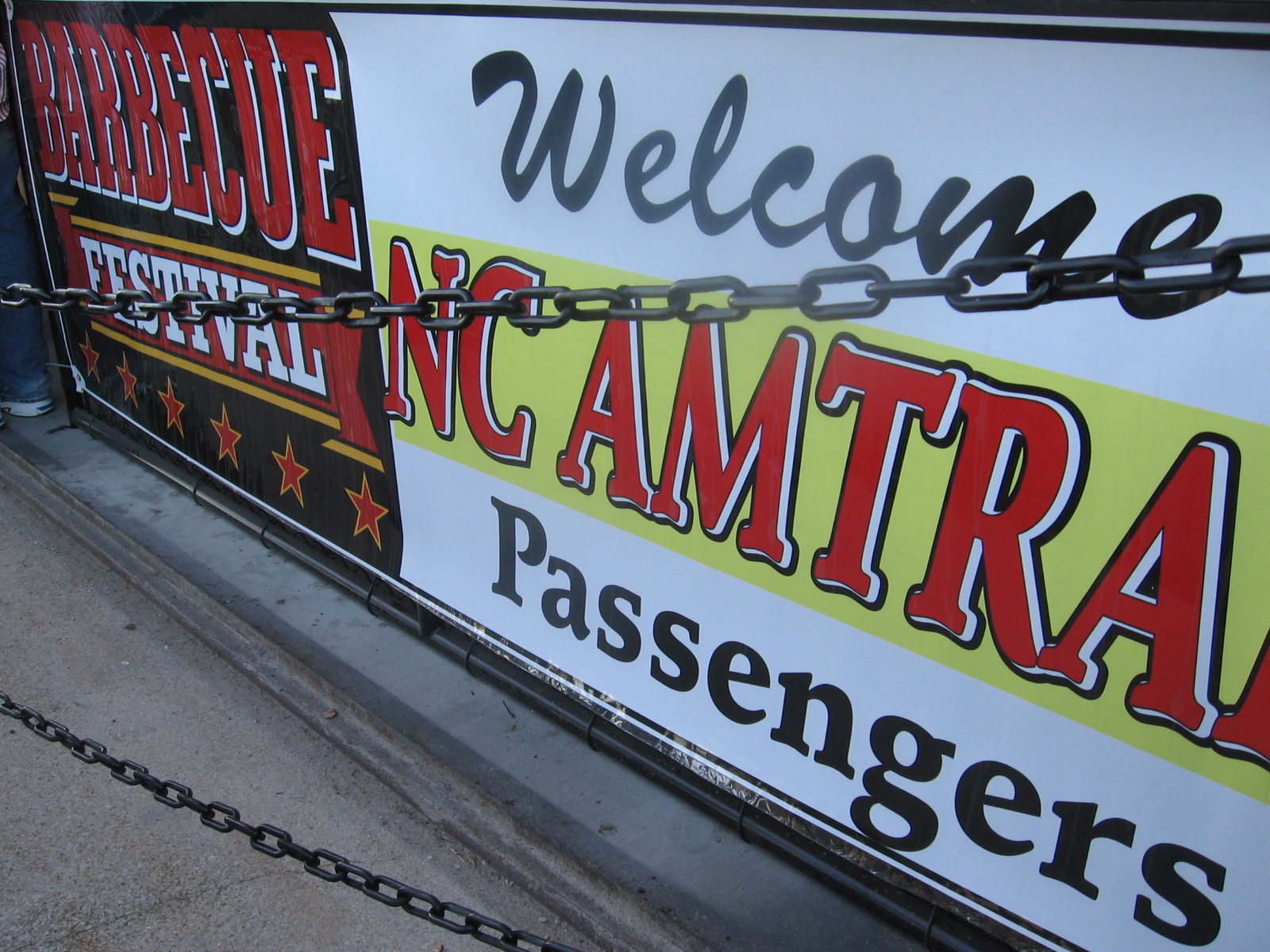
The weather was damn near perfect last weekend when the 27th Annual Barbecue Festival took over the streets of Uptown Lexington.  My wife and kids joined me on the Amtrak from Durham to Lexington (the one time a year the train stops there), and we were joined by dozens of other barbecue-happy passengers.  We even met some New Yorkers on the train–they’d come down from Long Island to Lexington just for the Festival, which speaks to how big the event has gotten over the years.  (Of course, maybe they were just trying to drown their Yankees’ baseball sorrows.) 

And when I say the event has gotten big, I mean it.  The Festival apparently drew a record crowd this year, with “more than 200,000” people in attendance according to the inexact-yet-official estimate.  That estimate might sound like hyberbole but if you were there–and given how large a crowd it was I am guessing you were–then you’ll have no problem believing it.  It was CROWDED, folks.  I don’t think I’ve ever seen that many people in one place and I am not sure I care to again.  But I did enjoy myself.  And luckily I ate a BBQ sandwich before the tents sold out–at 4:00 p.m., two hours before the end of the event. 

For excellent photos of the Festival, visit the website of Lexington’s daily, The Dispatch, by following this link and clicking on the October 24th festival gallery.